It is the line on a solar quote that surprises people most: "switchboard upgrade required." Sometimes it is genuine. Sometimes it is padding. This guide explains when a switchboard actually needs work before solar or a battery goes in, how to tell which situation you are in, and why it should be checked on site before anyone gives you a price.
We are licensed electricians as well as solar installers, and we see a lot of switchboards across the Gold Coast, Brisbane and Northern NSW. Here is how we think about it.
What the switchboard has to do
Your switchboard is where the power from the street, the solar and the battery all meet the circuits in your house. Adding solar or a battery means adding new circuits, isolators and protection to it. Under the Australian wiring rules, AS/NZS 3000, any new electrical work has to meet the current standard, even if the rest of the board was installed decades ago under older rules.
That does not mean the whole board has to be replaced every time. It means the new work has to be compliant, and there has to be safe, suitable space for it. Whether that is possible on your existing board is the whole question.
Signs you probably need an upgrade
Walk out to your meter box and have a look. These are the things we look for:
- Ceramic fuses. Old rewireable fuses in porcelain holders, common in homes built before the 1990s. They offer far less protection than modern circuit breakers and boards built around them rarely have room for anything new.
- No safety switches, or not enough. A safety switch, also called an RCD, cuts power in a fraction of a second when it detects current leaking to earth. Current rules require them on all final circuits in a home when new work is done. An older home may have one for the power points and nothing for lights, or none at all.
- An asbestos backing panel. Many Queensland homes built before about 1990 have a switchboard mounted on a dark grey or black fibrous panel. Treat it as asbestos unless it has been tested and proven otherwise. It cannot be drilled or cut, which means new equipment often cannot be mounted on it, and removing it is a licensed job.
- No physical space. Even a modern board can be full. A solar system needs its own circuit breaker and isolator, and a battery needs more. If there are no spare poles, the board needs extending or replacing.
- Old or undersized mains. The cable from the street and the main switch have a rating. A large battery or an electric vehicle charger can push a home beyond it, and that is a conversation about the supply, not just the board.
- Heat marks, buzzing or tripping. Discoloured breakers, a warm board or breakers that trip for no obvious reason are safety issues in their own right, solar or no solar.
If you see two or more of those, expect the upgrade to be real. If your board is a modern one with breakers, safety switches and spare space, be sceptical of a quote that insists on replacing it.
What "upgrade" actually includes
A proper switchboard upgrade for a solar and battery install typically covers:
- A new enclosure, or a clean extension of the existing one.
- Circuit breakers replacing any fuses.
- Safety switches on every final circuit, to the current standard.
- A surge protection device, which protects the inverter and the electronics in the house from lightning and grid surges. This is now standard on new work.
- Correctly rated, labelled isolators for the solar and the battery, so the system can be shut down safely.
- Safe handling or removal of any asbestos panel by an appropriately licensed person.
- A certificate of testing and safety for the work, which in Queensland is a legal requirement, not an optional extra.
What it should not include is vague line items with no explanation. If an upgrade is on your quote, ask exactly what is being done and why. A good electrician can point at the board and show you.
Single phase or three phase
Most Queensland homes are single phase. Larger homes, especially those with ducted air conditioning, a pool and workshop equipment, are sometimes three phase. This matters for solar because export limits, inverter choice and battery sizing all depend on it, and because upgrading from single to three phase is a network job, not just a switchboard one. It is one of the first things we check, because it changes the design before anything else is decided.
Why the on-site check matters
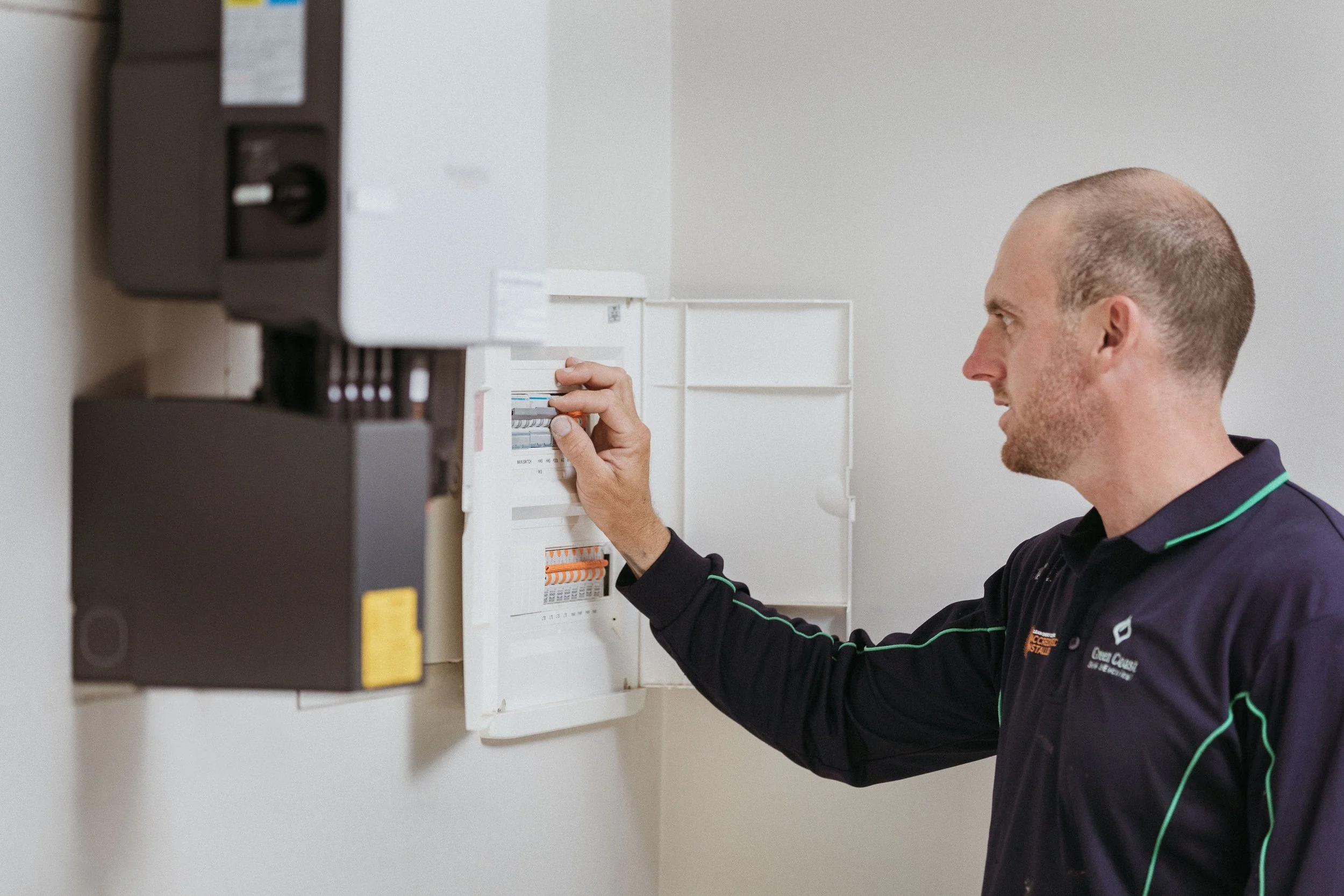
You can size a solar array from a satellite image and a power bill. You cannot assess a switchboard that way, and a battery install without a proper look at the board is guesswork. This is why every Green Coast job includes an on-site assessment before the final quote. We open the board, look at the mains, check for asbestos, count the spare ways and check the earthing. If an upgrade is needed, it is on the quote with an explanation. If it is not, it is not.
Customers sometimes tell us another installer quoted an upgrade sight unseen. Occasionally that turns out to be right. Often it does not. Either way, a price that arrives before anyone has looked at the board is a price that will change.
The electrical work we do beyond solar
Because we are a full electrical business, the switchboard work is done by our own licensed team as part of the same job, not handed to a third party. The same applies to the other electrical work that often comes up alongside a solar or battery install: hot water timers and diverters, EV charger circuits, air conditioning circuits, and general upgrades on older homes. One team, one warranty, one number to call.
If you are unsure what state your switchboard is in, or a quote has landed with an upgrade on it and you would like a second opinion, book a free consultation. We will talk through what you have, what the rules require, and what a properly done install looks like for your home. No pressure, no obligation.
Sources and further reading
General information only. Whether your switchboard needs work is confirmed by a licensed electrician on site. All electrical work is performed by appropriately licensed electricians in accordance with Australian Standards and Queensland electrical safety requirements.